This chapter will take you through the steps for selling your sports cards and the different places you can sell them - including their fees, pros & cons.
Selling a card involves the same steps no matter where you sell it - identify the card, work out its value, list it with clear photos and ship it safely. This chapter goes through each step, then compares the main places to sell sports cards and the fees each one charges.
Before you sell
1. Identify the card
Buyers search for cards using a specific set of details. Before listing a card, write down:
- Year.
- Manufacturer - for example Topps, Panini or Upper Deck.
- Set - for example Prizm, Chrome or Select.
- Player name(s).
- Card number - printed on the back of the card.
- Parallel/variant - for example Silver or Refractor.
- Serial number - if the card is numbered, for example 25/99.
- Features - Rookie Card (RC) logo, autograph or relic.
- Grade - if the card has been graded, for example PSA 10.
Each of these features is explained in What’s on a card?.
2. Check the value
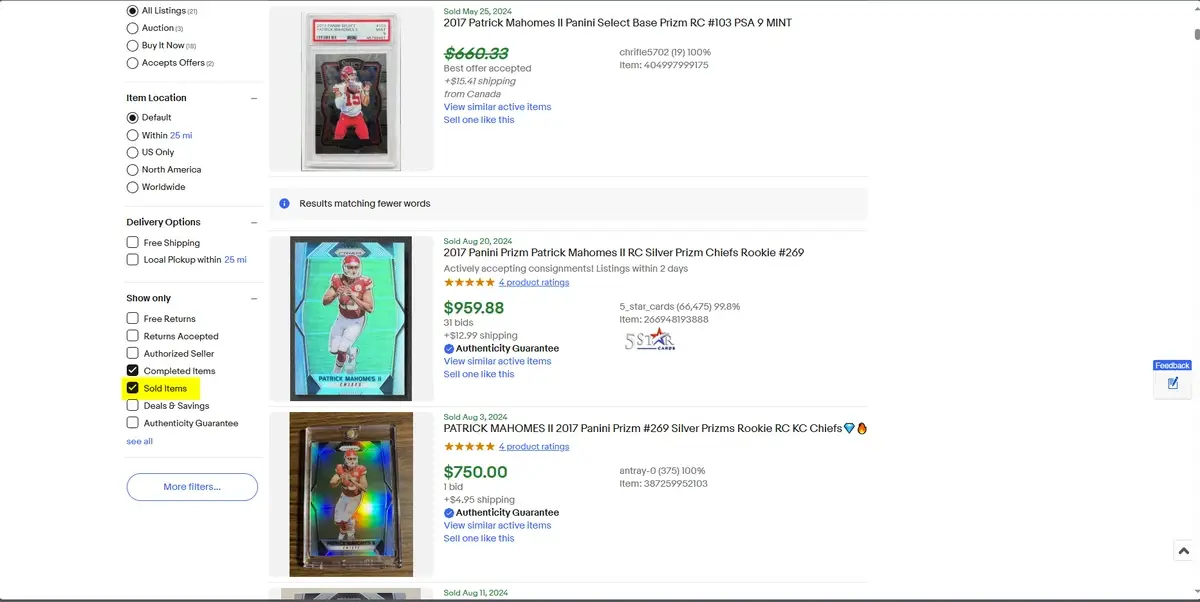
The value of a card is what buyers have recently paid for it - not the price sellers are asking. Recent sold listings on eBay are the main source for this. The steps for checking sold listings - along with other free and paid tools - are covered in How to check the value of a card?.
3. Decide whether to grade the card
A graded card has had its authenticity and condition checked by a grading company and is sealed in a labelled case (slab). Graded and ungraded (raw) copies of the same card sell for different prices, so compare the sold prices of both before deciding.
Grading costs money and takes time - each company charges a fee per card, and both the fee and the turnaround time depend on the service level chosen. How grading works and the main grading companies are covered in What is card grading and how does it work?, and the submission steps in How to get cards graded?.
4. Take clear photos
Buyers rely on photos to judge a card’s condition. Listings should include:
- A photo of the front and the back of the card.
- Even lighting with no glare on the card surface.
- Close-ups of the corners and edges.
- Close-ups of any damage or flaws - so the buyer knows exactly what they are getting.
5. Write the listing title
Use the same details buyers search with - in the same order as when checking a card’s value: Year + Manufacturer + Set + Player + Card number + Parallel/variant + Serial number + Grade. For example “2017 Panini Prizm Patrick Mahomes #269 Silver RC PSA 10”.
6. Choose a listing format
- Auction - buyers bid on the card and the highest bid when the auction ends wins.
- Fixed price (Buy It Now) - the card sells for the price you set.
- Fixed price with offers (Best Offer) - buyers can send you a lower offer, which you can accept, decline or counter.
Where to sell your cards
There are many places to sell sports cards - each with their own fees, pros and cons. The main options are below.
eBay
eBay has the largest volume of sports card sales and is the platform most buyers use to check card values.
eBay charges a final value fee - a percentage of the total sale amount - plus a per-order fee when an item sells. Fees differ by country, category and seller type (for example private sellers, business sellers and sellers with an eBay Store). Some countries have separate rules for private sellers - eBay Australia, for example, offers free selling to eligible Australia-based sellers without a Pro plan.
Current fees:
Pros
- Largest number of buyers for sports cards.
- Supports auctions, fixed price and Best Offer listings.
- eBay support can assist in dispute resolution.
- Payments are handled by eBay.
Cons
- Selling fees reduce the amount you receive (unless you qualify for free selling where eBay offers it).
- You are responsible for packing and shipping each card.
Facebook & Instagram
 |  |
Cards can be sold directly to other collectors through Facebook groups, Facebook Marketplace and Instagram. Each Facebook group sets its own rules for selling - check the rules of a group before posting a card for sale.
Payments are usually made through PayPal. Payments sent as goods & services are covered by PayPal’s protection policies and include a fee - the differences between payment types are covered in How should I pay for my cards?.
Pros
- No listing fees for posting in groups.
- Direct contact with buyers.
Cons
- No protection from the platform (Facebook or Instagram) for sales.
- Smaller audience than a marketplace site.
- You are responsible for collecting payment and shipping each card.
Live selling platforms - Whatnot and Fanatics Live
 |  |
Sellers host a live stream and sell cards to viewers - either by auction or at a fixed price. Both platforms charge a commission on each sale plus a payment processing fee. Whatnot’s commission rate depends on the category, the region and the seller’s sales volume. Sellers must apply and be approved before they can host a stream.
Current fees: Whatnot - Whatnot seller fees. Fanatics Live sets out its fees in its seller terms when you apply to sell.
Pros
- Many cards can be sold in a single stream.
- Payments are handled by the platform.
- The platform can assist in dispute resolution.
Cons
- Requires time to set up and host live streams.
- Auction prices depend on how many viewers are watching at the time.
COMC (Check Out My Cards)

COMC is a consignment service - you ship your cards to COMC, they photograph and list each card, store it, and ship it to the buyer when it sells. COMC charges a processing fee per card (which depends on the service level and whether the card is raw, graded or oversized), a fee when a card sells and a fee to withdraw sale proceeds as cash.
Current fees: COMC - Consignment fees.
Pros
- COMC photographs, stores and ships the cards for you.
- Suited to selling a large number of lower value cards.
Cons
- A processing fee is charged for every card - whether it sells or not.
- Processing times add time before cards are listed for sale.
Auction houses - Goldin, Fanatics Collect, Heritage Auctions
 |  |  |
Auction houses sell cards on consignment - you send the card to the auction house, which lists it in one of their auctions. Auction houses charge buyers a buyer’s premium and may also charge the seller a commission. Seller fees and minimum card values differ between auction houses - request the current terms from the auction house before consigning a card.
Pros
- Access to buyers of high-end cards.
- The auction house handles listing, payment and shipping to the buyer.
Cons
- Generally only accept higher value cards.
- Payment is received after the auction ends - which can be weeks after the card is consigned.
Local card shops (LCS) and trading card shows
Local card shops and dealers at trading card shows buy cards from collectors - either for cash or as a trade for other cards. Shops and dealers resell the cards they buy, so their offers are generally lower than the card’s recent sale prices.
Pros
- Paid immediately, in person.
- No packing or shipping required.
- Option to trade for other cards.
Cons
- Offers are generally lower than the card’s recent sale prices.
- Limited to the shops and shows near you.
Comparing selling options
| Option | Who ships the card? | Fees |
|---|---|---|
| eBay | You | Final value fee + per order fee - US / AU. |
| Facebook & Instagram | You | PayPal goods & services fee. |
| Whatnot / Fanatics Live | You | Commission + payment processing fee - Whatnot fees. |
| COMC | COMC | Processing fee per card + sale fee + cash out fee - COMC fees. |
| Auction houses | Auction house | Seller commission (varies) - buyers pay a buyer’s premium. |
| Local card shop / card show | No shipping | No fee - offers are below recent sale prices. |
Shipping your cards
Cards should be shipped the same way they are stored - in a card sleeve, then a toploader (see Protecting your cards).


- Place the card in a card sleeve, then into a toploader.
- Seal the top of the toploader (for example with painter’s tape) so the card cannot slide out.
- Ship the toploader in a padded (bubble) mailer or a rigid card mailer.
- Use a shipping service with tracking - tracking shows the card was delivered if a buyer reports that it never arrived.
- For higher value cards, add insurance and/or signature on delivery.