This chapter will take you through the differences between the four major card grading companies - including their grading scales, subgrades, special labels, autograph grading, prices and turnaround times.
PSA, BGS (Beckett), SGC and CGC all authenticate, grade and encapsulate sports cards, but each uses its own grading scale, labels and pricing. This chapter compares the four companies side by side. For an introduction to the grading standards and each company, see What is card grading and how does it work?. All details below are taken from each company’s official website.
 |  |
 |  |
Comparison table
| PSA | BGS | SGC | CGC | |
|---|---|---|---|---|
| Grading scale | 1 to 10 | 1 to 10 | 1 to 10 | 1 to 10 |
| Half-point grades | 1.5, and 2.5 to 8.5 | Yes - in 0.5 increments | 1.5 to 9.5 | 1.5 to 9.5 |
| Top grade(s) | Gem Mint 10 | Pristine 10, Gem Mint 9.5 | 10 Pristine, 10 Gem Mint | Pristine 10, Gem Mint 10 |
| Subgrades on label | Not listed as a service | Yes - centering, corners, edges and surface | Not listed as a service | Not listed as a service |
| Special labels | - | Black, Gold and Silver labels | - | Gold Pristine 10 label |
| Autograph grade scale | 1 to 10 | 5 to 10 (pack-pulled), no half grades | Offered - scale not listed on SGC pricing page | 5 to 10, no half grades |
| Current prices & turnaround | PSA Website | BGS Website | SGC Website | CGC Website |
Grading scales
All four companies grade cards from 1 to 10, with 10 being the highest grade. The differences are in which half-point grades are used and how the top of the scale is split.
PSA
- PSA’s top grade is Gem Mint 10, followed by Mint 9, NM-MT 8, NM 7 and so on down to Poor 1.
- Half-point grades are available between PSA 2 and PSA 9 (2.5 to 8.5) for cards that show high-end qualities within a grade, with a “clear focus on centering”. There is also a PSA 1.5 (Fair) grade.
- A PSA Gem Mint 10 must be centered within approximately 55/45 on the front and 75/25 on the back.
Source: PSA Grading Standards.
BGS (Beckett)
- Beckett grades from 1 (Poor) to 10 (Pristine) in half-point increments.
- A Pristine 10 requires 50/50 centering on the front and 55/45 or better on the back.
- A Gem Mint 9.5 requires 55/45 centering on the front and 60/40 or better on the back.
Source: Beckett Grading Scale.
SGC
- SGC has two 10 grades - 10 Pristine (“virtually flawless”, 50/50 centering) and 10 Gem Mint (55/45 or better centering).
- Below the 10 grades, SGC uses half points from 9.5 (Mint+) down to 1.5.
Source: SGC Grading Scale.
CGC
- CGC also has two 10 grades - Pristine 10 (50/50 centering, “virtually flawless” to the naked eye) and Gem Mint 10 (centering not to exceed approximately 55/45 on the front and 75/25 on the back).
- Below the 10 grades, CGC uses half points from 9.5 (Mint+) down to 1.5 (Fair).
- CGC updated its scale so that older CGC and CSG Gem Mint 9.5 grades are now treated as Gem Mint 10.
Source: CGC Cards Grading Scale.
Subgrades
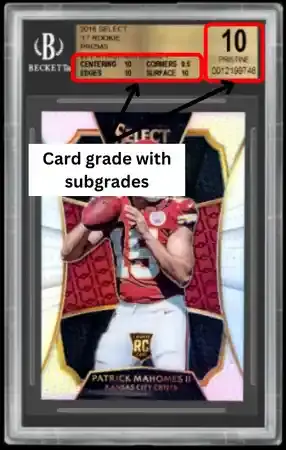
All four companies assess centering, corners, edges and surface (see chapter 6). Beckett states it is the only grading company to display all four of these scores - called subgrades - directly on the label.
Beckett’s lowest service level is offered both with and without subgrades, at different prices - see Beckett’s current pricing.
Special labels
BGS Black, Gold and Silver labels
Beckett colour-codes its labels by grade:
| Label | Grades |
|---|---|
| Black | Perfect Pristine 10s |
| Gold | Pristine 10 and Gem Mint 9.5 |
| Silver | All other grades |
On Beckett’s grading scale, the Pristine 10 Black Label requires 50/50 centering on the front and 55/45 or better on the back, corners that are “perfect to the naked eye and virtually flawless under intense scrutiny”, and a surface with no print spots, scratches or metallic print lines.
Source: Beckett Card Grading.
CGC Pristine 10 label
Cards that receive a CGC Pristine 10 - reserved for cards that are flawless under 10-times magnification - receive a special gold CGC Pristine 10 label. Source: CGC Sports Card Grading.
SGC and PSA
SGC separates its top grade into 10 Pristine and 10 Gem Mint on its grading scale. PSA’s highest grade is Gem Mint 10 and its scale does not include a Pristine grade.
Autograph grading
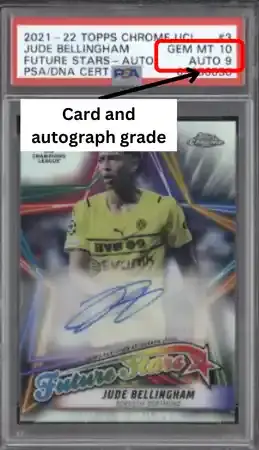
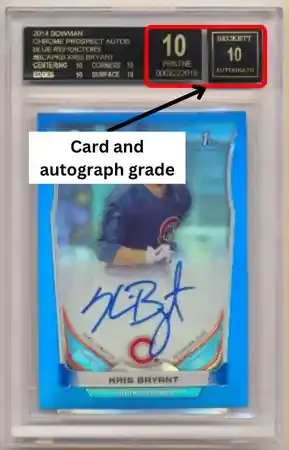
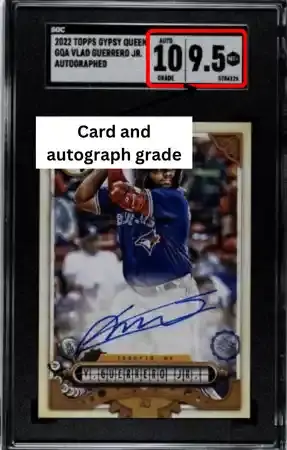
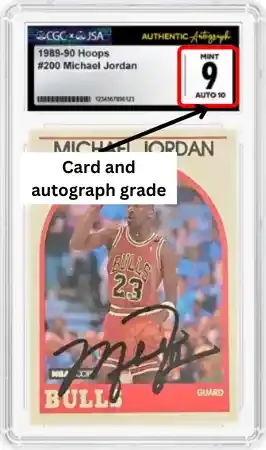
All four companies can grade an autograph separately from the card. The autograph grade is printed alongside the card grade.
PSA
PSA’s Dual Service authenticates both the card and the autograph, and gives each a grade on a 1 to 10 scale. Current Dual Service prices and turnaround times are listed on PSA’s pricing page under Card & Auto Grading. According to the PSA FAQ, autographed cards dated before 1998, or not certified by the manufacturer, must go through the Dual Service. Sources: PSA Card & Auto Grading, PSA FAQ.
BGS (Beckett)
- Pack-pulled autographs (cards with a printed manufacturer guarantee of the autograph) are graded on a 5 to 10 scale with no half points, for an extra fee per card. According to Beckett’s FAQ, the autograph grade is printed next to the card grade only if the autograph receives a 10 - lower autograph grades can be viewed online using the card’s serial number.
- In-person autographs (signed outside the manufacturing process) must first go through Beckett Authentication Services (BAS), where they are graded on a 1 to 10 scale, before the card is graded by BGS.
Source: Beckett Grading FAQ.
SGC
SGC grades autographs, with the autograph grade shown on the label next to the card grade (as in the example above). SGC’s public services and pricing page does not list the autograph grading scale.
CGC
CGC grades autographs on a 5 to 10 scale with no half grades. Autographs that are authentic but below a 5 receive the Authentic (AU) designation. Most pack-pulled autographs do not need separate authentication - autographs that do are authenticated through CGC x JSA, which costs extra on top of the card grading fee. Sources: CGC Cards Grading Scale, CGC Cards Services & Fees.
Slabs and labels
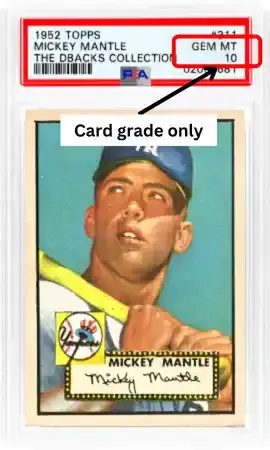
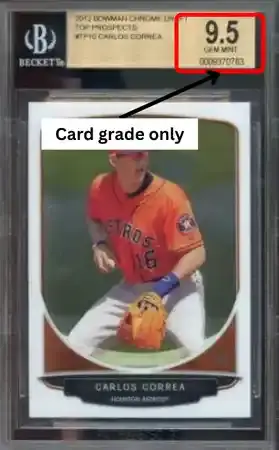
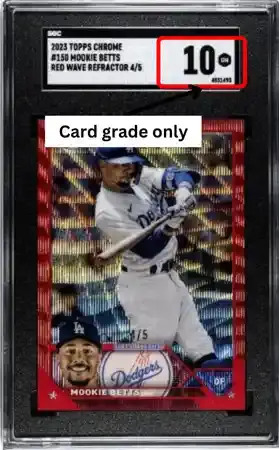
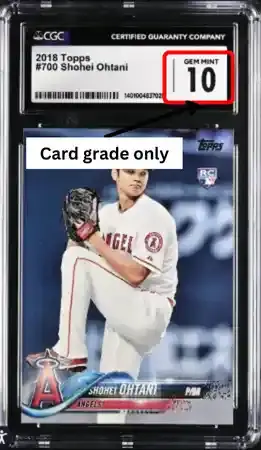
- PSA - every card is encapsulated in a tamper-evident, sonically sealed case. The grade and certification number are shown on the PSA LightHouse label. Source: PSA.
- BGS - Beckett’s current label uses holographic metallic material, a hidden UV pattern and a light-reactive badge to prevent counterfeiting, and every new label has a QR code to verify the certification number. Source: Beckett.
- SGC - certification numbers can be checked using SGC’s cert verification tool.
- CGC - the holder is ultrasonically welded. The label uses microprinting, UV ink, holographic foil and a unique certification number and barcode, with a QR code on the back. CGC’s thick card holder fits cards up to 7.25mm thick. Source: CGC Cards Holder and Label.
Prices and turnaround times
Each company prices grading by the declared value of the card and how quickly you want it back, and changes its prices and turnaround times often. Estimated turnaround times are not guaranteed by any of the four companies. What affects the cost of grading is covered in How to get cards graded?.
- PSA offers several service levels. Current prices and turnaround times: PSA - Trading Card Grading Services
- BGS offers several service levels, with its lowest level offered with or without subgrades. Current prices and turnaround times: Beckett - Grading Service Levels & Pricing
- SGC offers several service levels. Current prices and turnaround times: SGC - Card Grading Services and Fees
- CGC offers several service levels. Current prices and turnaround times: CGC Cards - Services & Fees
Crossovers - moving a graded card to another company
A crossover is when a card already graded by one company is sent to another company to be graded in its holder.
- CGC - accepts cards in PSA, Beckett or SGC holders, charged according to the service level. CGC only removes the card from its holder if it will receive the same or a higher grade, unless you choose “Cross at Any Grade”. The full fee applies even if the card does not cross. Source: CGC.
- SGC - crossovers are priced on the same table as raw card grading. SGC notes that crossovers submitted without a minimum grade will have longer turnaround times. Source: SGC.
- PSA - lists a Crossover service on its pricing page.
- BGS - lists a Graded Card Review option among the grading extras on its pricing page.
Once you have chosen a company, How to get cards graded? walks through the submission process step by step.